
Appeasing the Sea Post Tsunami training of helpers in Thailand – Phuket, 2025
Ofra Ayalon
Abstract
The following is a description of Helping the Helpers training for two hundred teachers and mental health workers from Thailand, Singapore, Malaysia and Indonesia six months after the Tsunami disaster. The goal of the training was to build support systems for disaster helpers, who would later treat the local populations who suffered directly or indirectly. The training program included theory and experiential activities concerning trauma, from a holistic coping model perspective, with sensitivity for specific cultural modes of response to processing loss. The article describes the multi-dimensional model of coping resources called ” BASIC Ph ” used in training crisis & disaster helpers & therapists throughout the world. A variety of body/mind activities such as movement, relaxation, healing touch, guided imagery and a variety of forms of art therapy. These methods helped develop strategies for coping with trauma, and demonstrated an effective means of assisting individuals, families, and even communities who were hurt by the Tsunami disaster.
The following is a description of Helping the Helpers training conducted in Thailand for two hundred teachers and mental health six months after the destruction of many coastal settlements in Thailand that claimed the lives of 5400 victims. Singapore, Malaysia and Indonesia. also joined to learn disaster intervention techniques that they were to apply back home.
The goal of the workshop was to build support systems for disaster helpers, who would later treat the local populations who suffered directly or indirectly.
movement, relaxation, eye contact & touch, guided imagery and a variety of forms of art therapy. These methods help develop strategies for coping with stress and trauma, and demonstrate an effective means of assisting individuals, families, and even communities who were hurt by the Tsunami disaster.
The training program included theory and experiential activities concerning trauma, from a holistic coping model perspective. with sensitivity for specific cultural modes of response to processing loss. The article describes the multi-dimensional model of coping resources called ” BASIC Ph ” used in training crisis & disaster helpers & therapists throughout the world.
Taweewan dared approach the seaside for the first time since the Tsunami storm ruined her homeland beach six months ago. Twenty family members of the 28 year old teacher perished in the disaster. In the appeasement ceremony that took place on the seaside on the Thai island of Phuket during the trauma processing workshop, Taweewan said:
“To my surprise, I feel some kind of tranquility in this meeting with the sea.
In Phuket the sea is the source of livelihood, and also a source of pain and sorrow. We invited participants to create their own symbols and return them to the sea, to make peace with it and to vent their feelings. The ceremony began when participants were asked to choose a color for guided drawing of personal security symbols. All the paintings of the symbols were hung on a rope between trees alongside the beachfront.
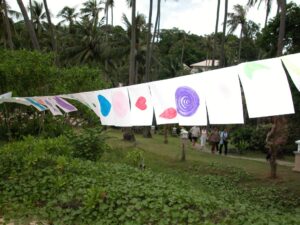
Picture no 1 – symbols of security
Additionally they painted their chosen color on shells and coral stones found on the beach and placed them on the water line, in silence or in prayer.
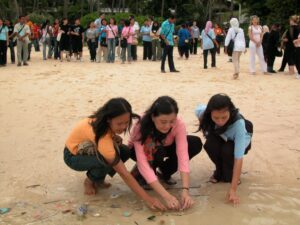
Picture no 2 – offering to the sea
In June 2005 two hundred teachers and mental health workers were divided into two consecutive workshops (one hundred in each) for trauma care, six months after the destruction of many coastal settlements in Thailand that claimed the lives of 5400 victims. People from Singapore, Malaysia and Indonesia also joined to learn disaster intervention techniques that they were to apply back home.
The two workshops, five-day each, were sponsored by the American-Jewish organization JDC, and aimed at training participants to use creative body-mind tools for healing trauma and loss. Workshop leaders were three Israeli experts: Dr. Ofra Ayalon, a trauma psychologist, Nira Shiran-Mizrahi, an art therapist, and Dr. Gillat Raisch, a pediatrician and family doctor. All three have international experience dealing with trauma and post-trauma resulting from wars, terrorism, road accidents, and natural disasters.
.The goal of the workshop was first and foremost to build support systems for disaster helpers, who would later treat the local populations who suffered directly or indirectly.
The workshop operated on two levels:
On the personal level trainers offered support to each participant. Recognizing the fact that helpers in disaster are vulnerable, we encouraged participants to process their experiences and receive support from colleagues and from us, their trainers. This empowering process was meant to prevent secondary traumatization and reveal participants’ personal coping resources.
On the professional level, the workshop exposed participants to our holistic body-mind approach to oping with trauma. We put special emphasis on non-verbal expression, such as movement, relaxation, eye contact & touch, guided imagery and a variety of forms of art therapy. These methods help develop strategies for coping with stress and trauma, and demonstrate an effective means of assisting individuals, families, and even communities who were hurt by the Tsunami disaster.
One hundred participants in each of the workshops gradually left the white upholstered chairs in the spacious auditorium and stretched out on the carpet. For five days we, the three facilitators, took turns leading the workshop. We presented theoretical information and conducted multi-sensory expressive experiential activities, aided by computer generated presentations of visual images, key points and themes.
Our program included essential theoretical information on different aspects of the traumatic response: anatomical and neurological aspects, psychological and social aspects, signs of the traumatic reactions, and our holistic model of coping methods. Participants received information and techniques they could later use to identify survivors who truly needed post traumatic care. They learned to recognize risk factors and to understand the traumatic and coping responses typical of children and adolescents. Through experiential learning they received information psych-educational methods of treatment and on the enhancement of coping skills.
Participants were helped to reach the pain that was hitherto locked up in their bodies and souls through body awareness, pain release, breathing and relaxation, movement, music and vocal healing, expression through color and shape, personal symbol-therapy and painting archetypal symbols and Mandalas.
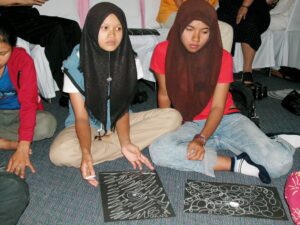
Picture no 3 – bringing light into the darkness
and narrating the trauma stories with the help of metaphoric cards. The Cards workshops were conducted in subgroups of 25. Participants were asked to choose two cards each, in search for a metaphor or visual description of their methods of coping with a traumatic events in their lives.
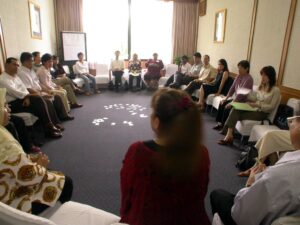
Picture no 4 – the cards’ circle
Half the cards were face up, while the other half were face down. The choice of the open card was meant to allow a feeling of control and mastery, while picking up a card at random created suspense and surprise, and allowed new learning and insight. While sharing in small groups a great number of stories of pain & loss emerged, some dating back to early childhood. It seems that the common disaster triggered previous loss and unresolved grief that were elicited by the pictures and shared in the confidence of the group. Having unloaded the emotional burden, participants were guided to look for their inner strength and find in the card the image of their coping skill.
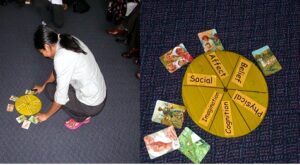
Pictures no 5 & 6 – COPE cards for telling the trauma story
“There was a session where I experienced an immense feeling of pain inside me. It’s hard to explain,” Worawit says. “Even after you share your feelings with your friends, at the end of the day you stay alone with your thoughts. That’s why this workshop was very important for me: It allowed me to deal with my own feelings, so later I could help other people.” It was especially valuable, she says, to help heal those who will, in turn, try to help others overcome the trauma they suffered.
Helpers may regain their balance by reconnecting their pre-disaster routines with how they functioned during the disaster and in its aftermath, and by enriching their professional “tool kit” with trauma-oriented methods and techniques.
enabled participants to cast light on the darkness of the trauma, to reinstate order in place of chaos and confusion, to fill memory gaps and to authenticate what had happened. Supportive listening lent legitimization to the most bizarre and unusual personal experiences.
Tsunami stories from different afflicted areas captured everyone’s attention. One participant, who in the past few months had refused to talk with local psychologists about her distress (“I was afraid that they will think that I was crazy “), described the despondent search for her mother, whose body was discovered three days after the destruction of her village. Another shared the devastating saga of her flight from the big wave to the nearby mountains, her feelings of anxiety and desolation, and also her gratitude for the food and shelter local residents gave her. A school counselor told of the painful disenchantment after the first “honeymoon phase of social cohesion: ” The disaster brought us together and created many instances of reciprocal help, but following the donation of money from other countries, suspicion and competition tore at the social fabric and the atmosphere deteriorated”. A sense of hopelessness echoed in some stories: ” I lost my trust in the world as a safe place.” Others expressed a collective guilt: “nature punishes people for destroying the environment”.
Our great challenge as Israeli trainers was the need to consider traditional and cultural differences and the variety of religious belief systems, such as Buddhism, Islam and Christianity, among the participants. They agreed that in general Southeast Asian culture does not provide channels for the expression of their distress. In their words, both men and women were expected to pretend that all was well, avoid expressing sorrow and weeping, refrain from discussing the disaster and endeavor to return to “life as usual.” These cultural norms conflicted with our basic assumption about the importance of discharge and personal expression. We had to be sensitive to the possibility of conflicting messages that could confuse our trainees.
Our solution to that dilemma was to employ the Eriksonian method of “pacing & leading”, (Rossi, 1986). “Pacing” or “joining” is a method of effective communication that enables the therapist to meet the clients within their own frame of reference, join them in their distress and understand their perspective from within their culture and their experience. “Pacing” relies on language, tone of voice and body language to create affinity, understanding and confidence. Once this is established we start “leading,” suggesting new ways of expression and conduct that help release participants from being stuck in the aftermath of their traumatic experience. The technique of “pacing and leading” employed in a cross-cultural situation demands that trainers pay special attention to participants’ non-verbal expression. “Pacing & leading” serves helpers to establish supportive contacts with varied populations of victims and survivors.
Survivors’ horror and anxiety may be contagious and affect the helpers. Often the exposure to traumatization of others triggered old traumas and flooded participants with memories of previous experiences of loss and grief they had not confronted. We attended to this by combining the theories of the dynamics of loss and grief with a lively exchange of information with the participants on bereavement rituals and ceremonies typical of their culture. This was followed by working in small groups in body/mind activities. Body-work, art-work and metaphoric story-telling cards generated many painful narratives of pre-tsunami times, such as childhood losses, parents’ death, separation from a mate, painful divorce and difficulties in daily life. Body/mind activities that enabled processing of loss and separation broke the dam of cultural self-restraint. Participants reacted emotionally to the “permission to cry.” They paired up to create a “buddy system” for mutual support while sharing old grief and pain with each other. The sharing and caring allowed the expression of grief, which was then contained and eventually reduced.
The theory and practice of “positive psychology” that focuses on natural resilience and coping resources was the central axis of the “helping the helpers” training. In contrast to clinical practice based on diagnosis of pathology, we stress people’s innate or acquired ability to sustain difficult conditions, to manage stress successfully and turn distress into an opportunity for growth. We applied this approach, developed in Israel, to the Tsunami workshops, using the multi-dimensional model of coping resources called ” BASIC Ph ” (Ayalon and Lahad, 1991 ; 2000 ; Lahad & Ayalon , 1994) used in training helpers and therapists throughout the world. ( Rosenfeld, Caye, Ayalon & Lahad, 2005 ) . ” BASIC Ph ” identifies six “coping channels”, that together form the spectrum of coping channels: Beliefs channel, Affect (feelings) channel , Social channel, channel of Imagination and creativity, Cognitive channel of logic and thinking & Physical channel of bodily activity. We apply this model (Lazarus, 1981; Ayalon, 1992; Lahad, 1993) with families, groups and communities during and in the aftermath of personal or communal trauma, in situations of uncertainty, loss, anger, aggression, and vindictiveness (Ayalon,1998). Every person chooses personal response channels from his or her inner resources, according to how the threat is perceived. Here follow examples of the variety of responses and coping methods.
Some people rely on belief in God or in supernatural powers: “At the time of the Tsunami I was praying in the mosque. The wave arrived abruptly, flooded the street, circumvented the mosque and did not touch it. A miracle happened and I was saved.”
Others search affective ways to express their feelings: “What helped me are positive feelings. I want to express my feelings simply and directly, like child”.
Many use their social skills in order to help or be helped: “I volunteered to help people who were hurt. Their suffering is much greater than mine. By helping others I helped myself”.
Some turn to imagination and creative channels: “With the help of the imagination I was saved from drowning. I imagined I saw a strong rope in the water. I seized it and pulled myself up. I was saved, in spite the fact that there was no rope in the water”.
.
I didn’t know how to manage a family. The children persuaded me to return to my studies. This made me stronger; I acquired a profession and now I am a teacher. I was saved by studying and thinking”.
Others tend to react by means of the body and prefer to engage in physical activity.” I had to immerse myself in the hard work of cleaning the debris of the storm. This was the only way I could manage my anxiety and sadness”. Another teacher said: “working with children I succeeded in calming them down by engaging them in vigorous movements, until they tired, sat quietly and breathed deeply”.
appropriate method of coping for all situations, all people or all ages. Each person, family, and community has their specific combination of coping channels, that constitute “the basic coping language.” The effective way to help in coping under stress and distress is for the therapist to join the victims’ basic language, and then guide them in developing additional coping resources.
Dr. Amporn Sornprasit of Prince Songkla University, our local partner in organizing the workshop, summed it up: “Only now we understand that we, in Thailand, need to be prepared in the event of another crisis. Here we are training the new cadre of helpers and teach them how to assist victims and their families.”
References
Ayalon, O. (1992) Rescue – Community stress preventive education. Ellicott City,
MD:Chevron Publishing Corporation.
Ayalon, O. (1998) Reconciliation – changing the face of the enemy. Community Stress
Prevention 3 pp.62-69.
Ayalon, O. (2003) The HANDS project: Helpers Assisting Natural Disaster
Survivors. Community Stress Prevention 5 pp.127-135.
Ayalon, O. (2005) Children’s response to terrorist attacks. In: D. Knafo (ed.) Living with
terror, working with trauma. New York: Jason Aronson. pp. 171-200.
Ayalon, O. & Lahad, M.( 1991; 2000) Life on the edge – stress & coping with high risk
situations. Haifa: Nord Publications.(Hebrew)
Figley, Ch. ( Ed. ) ( 1996 ). Compassion Fatigue. New York : Brunner / Mazel
Lahad, M. (2005). Communities coping with terrorism. In: E. Somer & A. Bleich
(Eds). Mental health in the shadow of terrorism – the Israeli experience.
Lahad, M. & Ayalon, O. (1994) On life & death. Haifa: Nord Publications..
Lazarus, A. (1981 ). The practice of multimodal therapy. New York : McGraw Hill.
Omer, H. & Alon, N. (1994) The continuity principle. Psychology 4, 1-2 pp 20-28.
Rosenfeld, L., Caye, J., Ayalon, O.& Lahad, M. ( 2005 ). When their world came
apart. Washington D.C.:NASW Press.
Rossi, E. (1986) The psycho-biology of mind/body healing. New York:W.W. Norton &
Co.
Appeasing the Sea
Post Tsunami training of helpers in Thailand
Phuket, 2005
Ofra Ayalon[1]
Abstract
The following is a description of Helping the Helpers training for two hundred teachers and mental health workers from Thailand, Singapore, Malaysia and Indonesia six months after the Tsunami disaster. The goal of the training was to build support systems for disaster helpers, who would later treat the local populations who suffered directly or indirectly. The training program included theory and experiential activities concerning trauma, from a holistic coping model perspective, with sensitivity for specific cultural modes of response to processing loss. The article describes the multi-dimensional model of coping resources called ” BASIC Ph ” used in training crisis & disaster helpers & therapists throughout the world. A variety of body/mind activities such as movement, relaxation, healing touch, guided imagery and a variety of forms of art therapy. These methods helped develop strategies for coping with trauma, and demonstrated an effective means of assisting individuals, families, and even communities who were hurt by the Tsunami disaster.
The following is a description of Helping the Helpers training conducted in Thailand for two hundred teachers and mental health six months after the destruction of many coastal settlements in Thailand that claimed the lives of 5400 victims. Singapore, Malaysia and Indonesia. also joined to learn disaster intervention techniques that they were to apply back home.
The goal of the workshop was to build support systems for disaster helpers, who would later treat the local populations who suffered directly or indirectly.
movement, relaxation, eye contact & touch, guided imagery and a variety of forms of art therapy. These methods help develop strategies for coping with stress and trauma, and demonstrate an effective means of assisting individuals, families, and even communities who were hurt by the Tsunami disaster.
The training program included theory and experiential activities concerning trauma, from a holistic coping model perspective. with sensitivity for specific cultural modes of response to processing loss. The article describes the multi-dimensional model of coping resources called ” BASIC Ph ” used in training crisis & disaster helpers & therapists throughout the world.
In Phuket the sea is the source of livelihood, and also a source of pain and sorrow. We invited participants to create their own symbols and return them to the sea, to make peace with it and to vent their feelings. The ceremony began when participants were asked to choose a color for guided drawing of personal security symbols. All the paintings of the symbols were hung on a rope between trees alongside the beachfront.
Picture no 1 – symbols of security
Additionally they painted their chosen color on shells and coral stones found on the beach and placed them on the water line, in silence or in prayer.
Picture no 2 – offering to the sea
In June 2005 two hundred teachers and mental health workers were divided into two consecutive workshops (one hundred in each) for trauma care, six months after the destruction of many coastal settlements in Thailand that claimed the lives of 5400 victims. People from Singapore, Malaysia and Indonesia also joined to learn disaster intervention techniques that they were to apply back home.
The two workshops, five-day each, were sponsored by the American-Jewish organization JDC, and aimed at training participants to use creative body-mind tools for healing trauma and loss. Workshop leaders were three Israeli experts: Dr. Ofra Ayalon, a trauma psychologist, Nira Shiran-Mizrahi, an art therapist, and Dr. Gillat Raisch, a pediatrician and family doctor. All three have international experience dealing with trauma and post-trauma resulting from wars, terrorism, road accidents, and natural disasters.
.
The goal of the workshop was first and foremost to build support systems for disaster helpers, who would later treat the local populations who suffered directly or indirectly.
The workshop operated on two levels:
On the personal level trainers offered support to each participant. Recognizing the fact that helpers in disaster are vulnerable, we encouraged participants to process their experiences and receive support from colleagues and from us, their trainers. This empowering process was meant to prevent secondary traumatization and reveal participants’ personal coping resources .
On the professional level, the workshop exposed participants to our holistic body-mind approach to oping with trauma. We put special emphasis on non-verbal expression, such as movement, relaxation, eye contact & touch, guided imagery and a variety of forms of art therapy. These methods help develop strategies for coping with stress and trauma, and demonstrate an effective means of assisting individuals, families, and even communities who were hurt by the Tsunami disaster.
One hundred participants in each of the workshops gradually left the white upholstered chairs in the spacious auditorium and stretched out on the carpet. For five days we, the three facilitators, took turns leading the workshop. We presented theoretical information and conducted multi-sensory expressive experiential activities, aided by computer generated presentations of visual images, key points and themes.
Our program included essential theoretical information on different aspects of the traumatic response: anatomical and neurological aspects, psychological and social aspects, signs of the traumatic reactions, and our holistic model of coping methods. Participants received information and techniques they could later use to identify survivors who truly needed post traumatic care. They learned to recognize risk factors and to understand the traumatic and coping responses typical of children and adolescents. Through experiential learning they received information psych-educational methods of treatment and on the enhancement of coping skills.
Participants were helped to reach the pain that was hitherto locked up in their bodies and souls through body awareness, pain release, breathing and relaxation, movement, music and vocal healing, expression through color and shape, personal symbol-therapy and painting archetypal symbols and Mandalas,
Picture no 3 – bringing light into the darkness
and narrating the trauma stories with the help of metaphoric cards. The Cards workshops were conducted in subgroups of 25. Participants were asked to choose two cards each, in search for a metaphor or visual description of their methods of coping with a traumatic events in their lives.
.
Picture no 4 – the cards’ circle
Half the cards were face up, while the other half were face down. The choice of the open card was meant to allow a feeling of control and mastery, while picking up a card at random created suspense and surprise, and allowed new learning and insight. While sharing in small groups a great number of stories of pain & loss emerged, some dating back to early childhood. It seems that the common disaster triggered previous loss and unresolved grief that were elicited by the pictures and shared in the confidence of the group. Having unloaded the emotional burden, participants were guided to look for their inner strength and find in the card the image of their coping skill,
“There was a session where I experienced an immense feeling of pain inside me. It’s hard to explain,” Worawit says. “Even after you share your feelings with your friends, at the end of the day you stay alone with your thoughts. That’s why this workshop was very important for me: It allowed me to deal with my own feelings, so later I could help other people.” It was especially valuable, she says, to help heal those who will, in turn, try to help others overcome the trauma they suffered.
Helpers may regain their balance by reconnecting their pre-disaster routines with how they functioned during the disaster and in its aftermath, and by enriching their professional “tool kit” with trauma-oriented methods and techniques.
enabled participants to cast light on the darkness of the trauma, to reinstate order in place of chaos and confusion, to fill memory gaps and to authenticate what had happened. Supportive listening lent legitimization to the most bizarre and unusual personal experiences.
Tsunami stories from different afflicted areas captured everyone’s attention. One participant, who in the past few months had refused to talk with local psychologists about her distress (“I was afraid that they will think that I was crazy “), described the despondent search for her mother, whose body was discovered three days after the destruction of her village. Another shared the devastating saga of her flight from the big wave to the nearby mountains, her feelings of anxiety and desolation, and also her gratitude for the food and shelter local residents gave her. A school counselor told of the painful disenchantment after the first “honeymoon phase of social cohesion: ” The disaster brought us together and created many instances of reciprocal help, but following the donation of money from other countries, suspicion and competition tore at the social fabric and the atmosphere deteriorated”. A sense of hopelessness echoed in some stories: ” I lost my trust in the world as a safe place.” Others expressed a collective guilt: “nature punishes people for destroying the environment”.
Our great challenge as Israeli trainers was the need to consider traditional and cultural differences and the variety of religious belief systems, such as Buddhism, Islam and Christianity, among the participants. They agreed that in general Southeast Asian culture does not provide channels for the expression of their distress. In their words, both men and women were expected to pretend that all was well, avoid expressing sorrow and weeping, refrain from discussing the disaster and endeavor to return to “life as usual.” These cultural norms conflicted with our basic assumption about the importance of discharge and personal expression. We had to be sensitive to the possibility of conflicting messages that could confuse our trainees.
Our solution to that dilemma was to employ the Eriksonian method of “pacing & leading”, (Rossi, 1986). “Pacing” or “joining” is a method of effective communication that enables the therapist to meet the clients within their own frame of reference, join them in their distress and understand their perspective from within their culture and their experience. “Pacing” relies on language, tone of voice and body language to create affinity, understanding and confidence. Once this is established we start “leading,” suggesting new ways of expression and conduct that help release participants from being stuck in the aftermath of their traumatic experience. The technique of “pacing and leading” employed in a cross-cultural situation demands that trainers pay special attention to participants’ non-verbal expression. “Pacing & leading” serves helpers to establish supportive contacts with varied populations of victims and survivors.
Survivors’ horror and anxiety may be contagious and affect the helpers. Often the exposure to traumatization of others triggered old traumas and flooded participants with memories of previous experiences of loss and grief they had not confronted. We attended to this by combining the theories of the dynamics of loss and grief with a lively exchange of information with the participants on bereavement rituals and ceremonies typical of their culture. This was followed by working in small groups in body/mind activities. Body-work, art-work and metaphoric story-telling cards generated many painful narratives of pre-tsunami times, such as childhood losses, parents’ death, separation from a mate, painful divorce and difficulties in daily life. Body/mind activities that enabled processing of loss and separation broke the dam of cultural self-restraint. Participants reacted emotionally to the “permission to cry.” They paired up to create a “buddy system” for mutual support while sharing old grief and pain with each other. The sharing and caring allowed the expression of grief, which was then contained and eventually reduced.
The theory and practice of “positive psychology” that focuses on natural resilience and coping resources was the central axis of the “helping the helpers” training. In contrast to clinical practice based on diagnosis of pathology, we stress people’s innate or acquired ability to sustain difficult conditions, to manage stress successfully and turn distress into an opportunity for growth. We applied this approach, developed in Israel, to the Tsunami workshops, using the multi-dimensional model of coping resources called ” BASIC Ph ” (Ayalon and Lahad, 1991 ; 2000 ; Lahad & Ayalon , 1994) used in training helpers and therapists throughout the world. ( Rosenfeld, Caye, Ayalon & Lahad, 2005 ) . ” BASIC Ph ” identifies six “coping channels”, that together form the spectrum of coping channels: Beliefs channel, Affect (feelings) channel , Social channel, channel of Imagination and creativity, Cognitive channel of logic and thinking & Physical channel of bodily activity. We apply this model (Lazarus, 1981; Ayalon, 1992; Lahad, 1993) with families, groups and communities during and in the aftermath of personal or communal trauma, in situations of uncertainty, loss, anger, aggression, and vindictiveness (Ayalon,1998). Every person chooses personal response channels from his or her inner resources, according to how the threat is perceived. Here follow examples of the variety of responses and coping methods.
Some people rely on belief in God or in supernatural powers: “At the time of the Tsunami I was praying in the mosque. The wave arrived abruptly, flooded the street, circumvented the mosque and did not touch it. A miracle happened and I was saved.”
Others search affective ways to express their feelings: “What helped me are positive feelings. I want to express my feelings simply and directly, like child”.
Many use their social skills in order to help or be helped: “I volunteered to help people who were hurt. Their suffering is much greater than mine. By helping others I helped myself”.
Some turn to imagination and creative channels: “With the help of the imagination I was saved from drowning. I imagined I saw a strong rope in the water. I seized it and pulled myself up. I was saved, in spite the fact that there was no rope in the water”.
.
I didn’t know how to manage a family. The children persuaded me to return to my studies. This made me stronger; I acquired a profession and now I am a teacher. I was saved by studying and thinking”.
Others tend to react by means of the body and prefer to engage in physical activity.” I had to immerse myself in the hard work of cleaning the debris of the storm. This was the only way I could manage my anxiety and sadness”. Another teacher said: “working with children I succeeded in calming them down by engaging them in vigorous movements, until they tired, sat quietly and breathed deeply”.
appropriate method of coping for all situations, all people or all ages. Each person, family, and community has their specific combination of coping channels, that constitute “the basic coping language.” The effective way to help in coping under stress and distress is for the therapist to join the victims’ basic language, and then guide them in developing additional coping resources.
Dr. Amporn Sornprasit of Prince Songkla University, our local partner in organizing the workshop, summed it up: “Only now we understand that we, in Thailand, need to be prepared in the event of another crisis. Here we are training the new cadre of helpers and teach them how to assist victims and their families.”
References
Ayalon, O. (1992) Rescue – Community stress preventive education. Ellicott City,
MD:Chevron Publishing Corporation.
Ayalon, O. (1998) Reconciliation – changing the face of the enemy. Community Stress
Prevention 3 pp.62-69.
Ayalon, O. (2003) The HANDS project: Helpers Assisting Natural Disaster
Survivors. Community Stress Prevention 5 pp.127-135.
Ayalon, O. (2005) Children’s response to terrorist attacks. In: D. Knafo (ed.) Living with
terror, working with trauma. New York: Jason Aronson. pp. 171-200.
Ayalon, O. & Lahad, M.( 1991; 2000) Life on the edge – stress & coping with high risk
situations. Haifa: Nord Publications.(Hebrew)
Figley, Ch. ( Ed. ) ( 1996 ). Compassion Fatigue. New York : Brunner / Mazel
Lahad, M. (2005). Communities coping with terrorism. In: E. Somer & A. Bleich
(Eds). Mental health in the shadow of terrorism – the Israeli experience.
Lahad, M. & Ayalon, O. (1994) On life & death. Haifa: Nord Publications..
Lazarus, A. (1981 ). The practice of multimodal therapy. New York : McGraw Hill.
Omer, H. & Alon, N. (1994) The continuity principle. Psychology 4, 1-2 pp 20-28.
Rosenfeld, L., Caye, J., Ayalon, O.& Lahad, M. ( 2005 ). When their world came
apart. Washington D.C.:NASW Press.
Rossi, E. (1986) The psycho-biology of mind/body healing. New York:W.W. Norton &
Co.
Winnicott, D.M. (1971) Playing and reality. Middlesex;Penguin Books.
[1] Dr. Ofra Ayalon[1]
NORD COPE Center, POB 76 tivon 36000 Israel.
email:nord@netvision.net.il
Winnicott, D.M. (1971) Playing and reality. Middlesex;Penguin Books.
[1] Dr. Ofra Ayalon[1]
NORD COPE Center, POB 76 tivon 36000 Israel.
email:nord@netvision.net.il