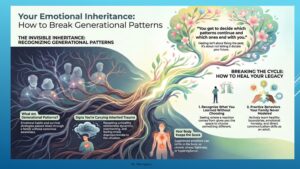
FAMILY HISTORY IS NOT DESTINY
Family Constellation, Genogram, and the BASIC Ph Model
in Multi-Generational Systems: Curiosity, Loyalty, and Liberation
Dr. Ofra Ayalon
Nord Cope Center, Israel 2026
www. https://nordcards.com
Abstract
Family systems extend beyond the visible present into a multigenerational field of memory, trauma, loyalty, and resilience. This article explores the integration of genogram analysis and Family Constellation work as complementary tools for uncovering hidden intergenerational dynamics. Drawing on systemic theory, psychodynamic concepts, trauma research, and ritual traditions, the paper illustrates how unprocessed losses, secrets, and exclusions shape present psychological functioning. Through clinical vignettes, the article demonstrates how systemic recognition and symbolic acknowledgment may transform inherited burdens into conscious choice, shifting individuals from shame and guilt toward curiosity and systemic integration.
Introduction: When the Past Lives in the Present
Clients often enter therapy convinced that their distress belongs entirely to them: my anxiety, my depression, my relational failure. Yet, as systemic and trauma research has increasingly demonstrated, psychic suffering frequently extends beyond the individual biography.
Family systems are living emotional matrices (Bowen, 1978). Within them, events that were never processed, war trauma, exile, suicide, abandonment, shame, forbidden love, miscarriages, do not disappear. They are absorbed, displaced, and sometimes embodied by later generations.
This chapter explores how genogram mapping and Family Constellation work may reveal these intergenerational transmissions. It further integrates the BASIC Ph coping model (Lahad, 1992; Ayalon & Lahad, 1993) as a multi-dimensional framework for understanding how inherited trauma and resilience are encoded across belief systems, affect, social bonds, imagination, cognition, and physiology.
The central clinical movement is this:
From personal shame → to systemic curiosity.
From unconscious loyalty → to conscious differentiation.
Emotional Transmission through the Multi-Generational Lens
Murray Bowen conceptualized the family as an emotional unit governed by multi-generational transmission processes. Differentiation of self is not achieved in isolation; it evolves through the capacity to remain connected while thinking autonomously (Bowen, 1978).
Symptoms often reflect systemic anxiety traveling across generations.
The Family Unknown: Secrets, Silence, and Systemic Shadows
Anne Ancelin Schützenberger (1998) introduced the concept of the “ancestor syndrome,” describing unconscious identifications with forgotten relatives. These invisible loyalties are rarely deliberate; they are systemic attempts to restore balance. Carl Jung’s concept of the collective shadow (Jung, 1959) offers a parallel: what is excluded seeks expression.
Clinical Example: The Invisible Suicide
Leah, 41, presented with persistent guilt and intrusive anxiety without an identifiable cause. A three-generation genogram revealed a great-aunt who died by suicide in the 1940s. She had been erased from family narratives. In a constellation session, Leah symbolically addressed the forgotten aunt:
“I see you. You belong. I leave your fate with you.”
Following this intervention, Leah’s anxiety episodes reduced markedly over six months. The shift was not magical; it involved cognitive reframing, emotional processing, and embodied differentiation. The burden moved from personal defect to inherited echo.
The Genogram: Mapping Inter-generational Patterns
The genogram is one of the most widely used tools in systemic family therapy (McGoldrick, Gerson, & Petry, 2008). Unlike a traditional family tree, a genogram documents emotional relationships, significant life events, and behavioral patterns across generations.
Genograms typically include information about:
- Births, marriages, divorces, and deaths
- Migration and historical events
- Psychiatric and medical histories
- Addictions, suicides
- Divorce and abandonment patterns
- Religious and cultural values
- Secrets and exclusions
When expanded to three or more generations, patterns emerge that are invisible within a single lifespan.
Through the construction of a genogram, therapists and clients may identify recurring patterns. Genograms transform fragmented memories into a coherent systemic map, enabling individuals to see the connection of their emotional experiences within the broader family history.
For example, a client with persistent anxiety may discover through genogram exploration that several women in the maternal lineage experienced early widowhood. Her fear of loss may therefore reflect not only personal experience but also a broader intergenerational narrative.
Family Secrets and Hidden Loyalties
Family systems frequently contain secrets related to events associated with shame, guilt, or trauma. These may include: suicide or premature death, abuse or violence, illegitimacy or adoption, criminal behavior, or mental illness. Family secrets often persist across generations. Silence may protect family members from painful emotions or preserve the family’s social image. However, the psychological cost of secrecy can be harmful. Hidden narratives may create confusion, anxiety, or unconscious identification with excluded family members.
Boszormenyi-Nagy and Spark (1973) introduced the concept of invisible loyalties, referring to unconscious commitments to family members that influence behavior across generations. For instance, a grandchild may unconsciously identify with a forgotten relative who experienced abandonment or exclusion. This identification may manifest as feelings of guilt, self-sacrifice, or unexplained emotional burdens.
Family Constellation: An Exploration of past and present relationships
Family Constellation therapy, developed by Bert Hellinger (1998), explores relationships within family systems, following Virginia Satir’s practice of “Family Reconstruction” (Satir, (1988; Ayalon, 2019). In Constellation work, participants represent living or dead family members, and their relations to each other.
The method is based on several principles:
- Families function as interconnected systems across generations.
- Excluded or forgotten members continue to influence the system.
- Acknowledgment and recognition can restore systemic balance.
During Constellation processes, previously hidden dynamics may become visible through the emotional responses of representatives within the constellation field.
For example, Sara, who was experiencing unexplained anxiety, discovered during a constellation session that her great-aunt, who died by suicide, had been erased from family narratives. Through ritualistic and symbolic recognition of the expelled ancestor, Sara has experienced relief from a burden that had plagued her unknowingly.
Although family constellation work remains controversial within academic psychology, many clinicians report that it can facilitate powerful experiential insights into family dynamics (Cohen, 2006).
Integrating BASIC Ph: A Multidimensional Map of Inter-generational Coping
The BASIC Ph model (Ayalon & Lahad, 1993) identifies six coping channels:
- B – Belief and values
- A – Affect, emotional intelligence
- S – Social and family connections
- I – Imagination and creativity
- C – Cognition and problem solving
- Ph – Physiology: brain, body, and action
- Families often transmit dominant coping styles across generations. For example:
Belief (B)
A family emphasizing belief systems may rely on faith and moral values during crises.
Families transmit implicit messages, such as:
- “We survive by silence.”
- “We never show weakness.”
- “Success compensates for loss.”
In constellation work, such limiting belief systems are surfaced, examined, and transformed.
Clinical Example:
A client raised in a Holocaust-survivor family carried the belief: “Joy is dangerous.” Recognizing its origin allowed reconstruction of a more adaptive belief: “Joy honors survival.”
Affect (A)
Unprocessed grief often bypasses language. It becomes diffuse anxiety or irritability in later generations. Danieli (1998) documented how trauma survivors’ emotional styles influence descendants’ attachment patterns.
Clinical Example: The Miscarriage
In one family, a miscarriage between the births of two healthy children was never mentioned. The younger sibling developed chronic depression. When parents acknowledged the loss and grieved symbolically in the therapy session, emotions in the family shifted. Recognition of the loss tension restored emotional balance and relief, as the little boy did not have to carry the unspoken grief on his own.
Social & Family (S)
A family emphasizing social coping may mobilize extended support networks.
Patterns of isolation, betrayal, or scapegoating repeat across generations.
Clinical Example:
A pattern of eldest sons leaving home abruptly recurred in a family over four generations. The Genogram revealed a great-grandfather expelled from his community in shame. Each consecutive departure unconsciously reenacted this exile. A symbolic ritual of recognition and respect for the outcast ancestor broke the chain of transmitted social loyalty and opened up a new way of connection within the family.
Imagination (I)
Symbols, dreams, and metaphors carry systemic memory. Guided Imagery Constellations (even via Zoom) allow clients to encounter internalized ancestors symbolically. Imagination becomes a safe laboratory for healing generational wounds.
Cognition (C)
A family emphasizing cognitive coping may use problem-solving and rational planning, and the therapist translates complaints into cognitive reframing: “Your suffering makes sense given your family history.” Meaning reduces chaos.
Physiology (PH)
Trauma is reflected in the body in many ways. Research by Yehuda et al. (2016) demonstrates epigenetic changes in descendants of trauma survivors. Physiological transmission from former generations is increasingly supported by stress-biology research (Van der Kolk, B. 2014).
Understanding these patterns allows therapists to identify both resources and limitations within family coping systems.
In constellation sessions, clients frequently report somatic shifts, lighter breathing, relaxed shoulders, warmth in the chest, following such symbolic recognitions. Embodied owning of these symptoms helps to discard them as part of healing.
Curiosity as a Transformative Force
Curiosity can be understood as a psychological drive to reduce uncertainty and expand knowledge. Within family systems, curiosity often emerges in relation to unanswered questions about family history:
- Why do certain patterns repeat in our family?
- What happened to relatives who are rarely mentioned?
- Why do some events remain unexplained?
Curiosity upsets and interrupts rigid loyalty patterns in trauma-laden systems, and may be perceived as betrayal. Curiosity may be experienced as threatening within families that rely on silence or denial to preserve their psychological stability.
Children learn: “Do not ask about that uncle.” “Do not speak of the war.” “Do not question mother’s silence.” Constellation therapy creates a safe place for curiosity, shifting from: “Who is guilty?” To: “What remains unspoken?” Thus, curiosity is acceptable and even rewarded.
Ancestors and Ritual: Between Anthropology and Psychology
Hellinger’s exposure to Zulu ancestor rituals informed his systemic approach. In many cultures, ancestors remain part of the relational field. The practice of relating with our ancestors is woven into many, if not every, cultural tradition.
Though Rupert Sheldrake’s “morphic resonance” remains controversial (Sheldrake, 1988), the metaphor of a “field of knowledge” resonates clinically. Families carry unspoken generational emotional memory. Family Constellation therapy reframes “ancestors’ acknowledgment” as symbolic integration and healing. The goal is empowerment of the present, not fatalistic surrender to the past. Family history is not necessarily destiny.
From Inherited Burden to Chosen Identity
Inter-generational work does not seek to dissolve family bonds but to restore balance.
Healing movement involves: Acknowledging losses, allocating past failures and tragedies to their rightful owners, and identifying inherited strengths. Resilience, like trauma, is transmitted.
Conclusion
Families carry complex emotional legacies across generations. Trauma, resilience, beliefs, and coping strategies are transmitted through narratives and unconscious loyalties.
Curiosity serves as a bridge between past and present. It motivates individuals to explore hidden family histories and to integrate previously silenced narratives into a coherent identity.
Through tools such as Genograms and Family Constellation work, therapists can help participants understand the broader context of their emotional experiences. Looking through the lenses of the BASIC Ph coping model highlights the ways in which families transmit both vulnerability and resilience across generations. These practices provide a full framework for addressing inter-generational suffering and help to create a major transformation within the family system:
Shame becomes shared history. Loyalty becomes a conscious choice. Silence becomes recognition. Trauma becomes narrative.
When the source of inherited pain is acknowledged, relief may emerge, even if the event occurred generations ago. Healing does not erase history. It restores proportion, ownership, and hope.
References
Ayalon, O. (2019). Virginia Satir: Cross-cultural Family Therapy Model. www.nordcards.com
Ayalon, O. & Lahad, M. (1993). BASIC PH: A coping resources model for stress and trauma. In O. Ayalon & M. Lahad (Ed.), Community stress prevention. CSPC.
Bowen, M. (1978). Family therapy in clinical practice. Jason Aronson.
Danieli, Y. (1998). International handbook of multigenerational legacies of trauma. Springer. https://doi.org/10.1007/978-1-4757-5567-1
Hellinger, B. (1998). Love’s hidden symmetry. Zeig, Tucker & Theisen.
Jung, C. G. (1959). The archetypes and the collective unconscious (2nd ed.). Princeton University Press. https://doi.org/10.1515/9781400850969
Lahad, M. (1992). Story-making in assessment method for coping with stress. Dramatherapy, 14(2), 27–33.
McGoldrick, M., Gerson, R., & Petry, S. (2008). Genograms: Assessment and intervention (3rd ed.). W. W. Norton.
Satir, V. (1988). The new peoplemaking. Science and Behavior Books.
Schützenberger, A. A. (1998). The ancestor syndrome. Routledge. https://doi.org/10.4324/9780203425726
Sheldrake, R. (1988). The presence of the past. Times Books.
Van der Kolk, B. (2014). The Body Keeps the Score: Brain, Mind, and Body in the Healing of Trauma. Penguin Group, USA.
Yehuda, R., et al. (2016). Holocaust exposure induced intergenerational effects on FKBP5 methylation. Biological Psychiatry, 80(5), 372–380. https://doi.org/10.1016/j.biopsych.2015.08.005